

What if the secret to a pristine lawn isn't about winning a battle against nature, but simply redirecting it? Many British gardeners find themselves caught in a cycle of frustration when badgers dig up turf or deer strip the bark from prized shrubs. It's a common struggle; you want a beautiful space, but you also care about the local ecosystem. Using effective wildlife deterrents for gardens allows you to protect your plants whilst maintaining your ethical standards.
We understand that your garden is a sanctuary for your family and your pets. You shouldn't have to worry about the safety of traditional poisons or the unpleasant task of cleaning up after local wildlife. This 2026 guide provides a modern approach to garden protection that aligns with the latest UK environmental targets and species abundance goals. We will explore how to use natural, non-toxic methods to discourage foxes, deer, and rodents. You'll learn how to maintain a pristine outdoor space through gentle sensory intervention rather than aggression. Our focus is on providing you with peace of mind and a garden where nature and home life coexist in quiet harmony.
Key Takeaways
- Identify common garden visitors and understand the shift from traditional pest control to modern, ethical wildlife management.
- Explore how scent-based wildlife deterrents for gardens use natural olfactory triggers to signal unfavourable territory to foxes, deer, and rodents.
- Learn why clay-based granules provide more reliable, long-lasting protection than ultrasonic devices or inconsistent home remedies.
- Discover the practical differences between perimeter protection and spot treatments to create a tailored strategy for your specific garden layout.
- Achieve a pristine outdoor space and peace of mind by using humane methods that are safe for pets and the broader British ecosystem.
Understanding Wildlife Presence in British Gardens
Sharing your garden with nature is a rewarding part of British life. However, when your lawn is dug up or your roses are eaten, it's natural to seek a solution. Choosing the right wildlife deterrents for gardens starts with understanding who exactly is visiting your outdoor space. Identifying the visitor allows you to apply a targeted, ethical strategy that works with the animal's natural instincts rather than against them. It's about finding a way to coexist that respects both your hard work and the local fauna.
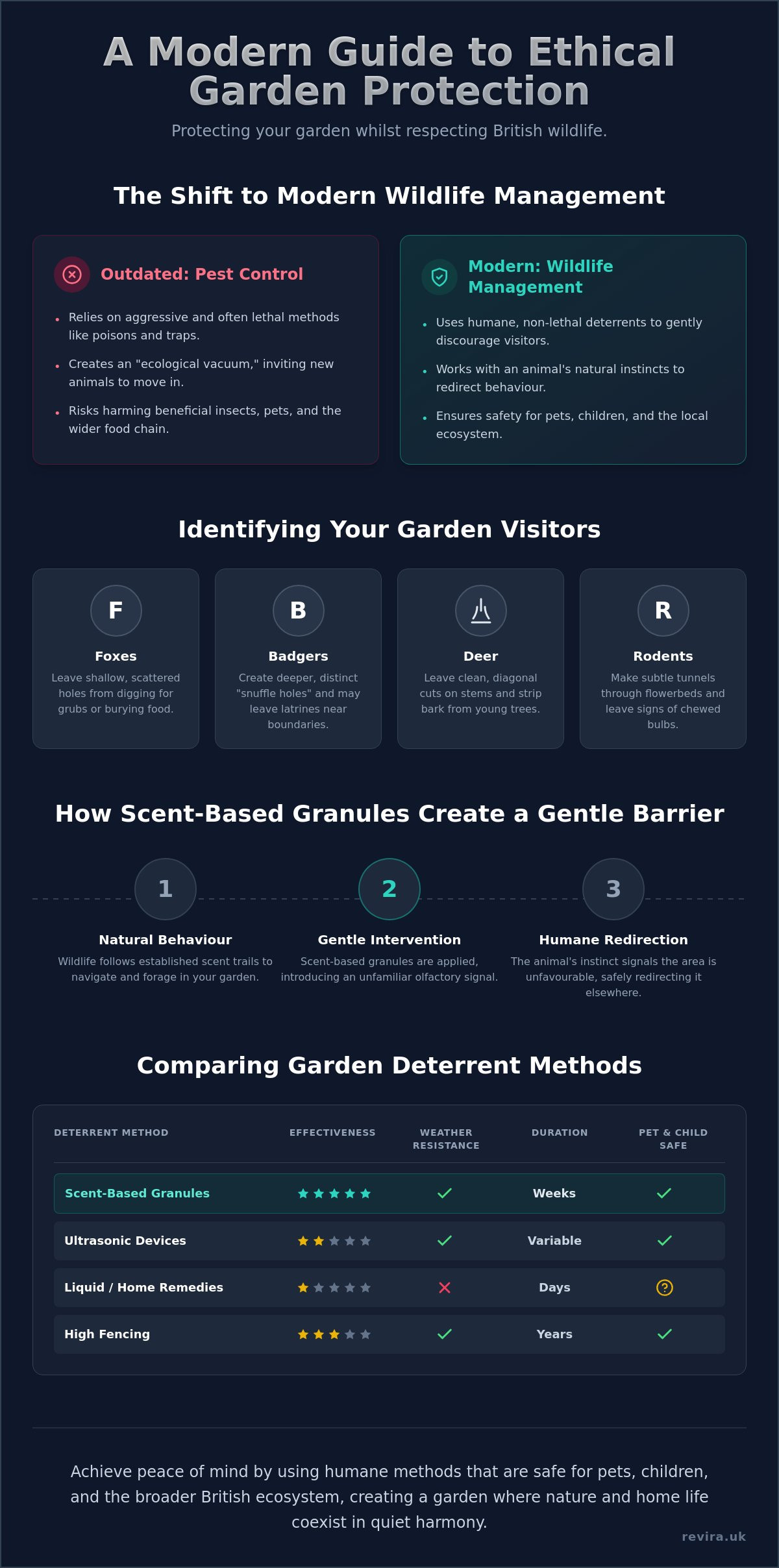
Modern gardening has evolved significantly. We've moved away from the outdated concept of "pest control" and towards established Wildlife management principles. This shift acknowledges that animals are part of a healthy ecosystem, even if they aren't always welcome in certain areas. Traditional exclusion methods, like high fencing, often fall short of expectations. Foxes are agile climbers; badgers are powerful diggers. A determined visitor will usually find a way around or under a physical barrier. Effective protection requires a more sophisticated approach than simply trying to build a wall around your flowerbeds.
Signs of Wildlife Activity
Identifying the culprit is the first step toward a solution. Fox activity often results in shallow, scattered holes in the lawn where they hunt for grubs or bury food. Badgers, by contrast, leave deeper, more distinctive "snuffle holes" and may create latrines near your boundaries. Deer damage is equally specific; they leave clean, diagonal cuts on woody stems and strip bark from young trees at head height. Smaller visitors like voles and mice leave subtle tunnels and chewed bulbs amongst your flowerbeds. Recognising these patterns ensures you don't waste time on the wrong strategy.
The Ethics of Non-Lethal Discouragement
The Science of Scent-Based Deterrence: How Granules Work
Animals perceive the world through a complex map of smells. For a fox or a badger, a garden isn't just a collection of plants; it's a sensory landscape of opportunities and risks. Scent-based wildlife deterrents for gardens work by subtly altering this landscape. By introducing specific olfactory triggers, we can signal to a visitor that a particular area is "unfavourable territory". This doesn't cause the animal any physical pain or distress. Instead, it taps into their deep-seated survival instincts, suggesting that it's safer and easier for them to forage or nest elsewhere. It's a sophisticated way to manage boundaries without resorting to aggressive measures.
The effectiveness of this method relies heavily on the delivery system. Many gardeners have tried home remedies or liquid sprays, only to find they fail after the first rainfall. Clay-based granules solve this problem through their unique structure. These porous carriers absorb the active scent and release it at a controlled rate, ensuring the barrier remains potent for weeks. This weather-resistant advantage is crucial in the UK climate. Whilst liquids simply wash into the soil, granules remain on the surface, continuing to provide a reliable signal even after heavy downpours.
Olfactory Communication in the Animal Kingdom
Mammals like foxes and cats use scent marking to define their territory and navigate their environment. By introducing a different, discouraging scent, you disrupt their established "scent trails". This signals to the animal that their usual route is no longer secure, prompting them to move elsewhere. Scent-based deterrence is a non-toxic method that bypasses the need for physical barriers by communicating directly with an animal's survival instincts. This approach aligns with the use of humane deterrents recommended by welfare organisations to ensure garden protection doesn't cause unnecessary distress.
Safety for Pets and Children
In a family garden, safety is non-negotiable. Traditional chemical sprays often leave behind residues that can be tracked into the home or accidentally ingested by pets. Clay-based granules offer a cleaner alternative. The active ingredients are bound to the natural clay carrier, meaning there is no liquid runoff or airborne mist to worry about. This "clay-carrier" method ensures that the deterrent stays exactly where you put it. It provides a reliable layer of protection that is entirely safe for children to play around. If you're looking for a dependable way to protect your borders, our clay-based deterrent granules offer a practical, family-friendly solution that respects the natural world.
Comparing Deterrent Methods: Why Granules Outperform Devices
Choosing the right wildlife deterrents for gardens often involves a choice between high-tech gadgets and traditional methods. Many gardeners start with electronic devices, attracted by the promise of a "set and forget" solution. In reality, these products often struggle to cope with the complexities of a typical British landscape. From the way sound travels to the durability of the materials used, the practical differences between granules and devices are significant. Reliability in the damp UK climate is usually the deciding factor for most experienced homeowners.
The Problem with Ultrasonic Sound
Ultrasonic devices are limited by the laws of physics. High-frequency sound waves do not penetrate solid objects. Common garden features like brick walls, garden sheds, or even dense privet hedges create "shadows" where the sound is completely blocked. If a fox enters your garden through a gap behind a shed, an ultrasonic sensor on the lawn will never detect it. There is also the problem of habituation; animals are highly adaptable and often learn that the noise carries no real consequence. Crucially, older animals with hearing loss are entirely unaffected, making these devices an unreliable choice for consistent protection.
Granules vs. Chemical Sprays
Liquid deterrents are frequently used, but they are incredibly volatile. They evaporate quickly in the sun and are easily washed into the soil by rain, requiring constant reapplication to remain effective. Environmental factors also play a role; sprays can easily drift in the wind, potentially affecting areas of your garden where you want to encourage biodiversity. Clay-based granules offer significantly greater longevity than liquid sprays because the natural clay carrier protects the scent from the elements and ensures a methodical, slow-release delivery. This approach provides a nature-friendly way to secure your borders without the risk of chemical runoff.
Home remedies like pepper dust or exotic animal dung are often suggested in gardening forums, but they rarely provide the consistency needed for long-term results. They are messy to apply and lose their potency almost immediately when exposed to moisture. In contrast, scent-based granules offer a discreet and professional alternative for those seeking effective wildlife deterrents for gardens. They are virtually invisible once applied, blending seamlessly into your flowerbeds or lawn edges. This maintains the visual appeal of your space, unlike plastic electronic stakes which can look out of place in a traditional garden. When you consider the cost-effectiveness, granules often outperform gadgets; you avoid the high upfront price of electronics and the ongoing cost of batteries, investing instead in a durable sensory barrier that works with the animal's natural instincts.
Tailored Strategies for Specific Garden Visitors
Effective garden protection isn't a one-size-fits-all task. Every outdoor space has a unique layout, and every animal has different motivations for visiting. To achieve the best results with wildlife deterrents for gardens, you must think like a detective. Identifying entry points, such as pushed-down grass or gaps under a fence, allows you to apply a targeted strategy. It's important to remember that deterrence is a process of education, not an instant "off" switch. Animals are creatures of habit; they need time to encounter your new scent boundary and learn that your garden is no longer a preferred territory.
We recommend a dual approach: perimeter protection and spot treatment. Perimeter protection involves creating a continuous boundary around the edge of your property to discourage animals from entering in the first place. Spot treatment focuses on high-value areas, like a prize rose bush or a specific vegetable bed. By combining these methods, you provide a clear and consistent message to any visitor. This approach also helps manage habituation, as the animal is constantly reminded of the boundary at every potential point of interest.
Stopping Foxes and Deer
Deer are persistent browsers that can strip the bark from saplings or ruin a season's worth of roses in a single night. For these visitors, focus on protecting the foliage at head height and treating the main paths they use to enter the garden. Foxes are often attracted to the shelter provided by decking or sheds. Creating a scent barrier around the base of these structures discourages them from digging or nesting. For both species, reapplication is vital during peak activity seasons, such as the spring when young are being fed or the autumn when food sources become more scarce.
Managing Cats and Rodents
The unpleasant task of cleaning up cat fouling is a common frustration for British gardeners. Cats often choose soft, tilled soil in vegetable patches or pristine lawn edges. Applying granules to these specific areas provides a humane way to redirect their behaviour whilst keeping the cat next door entirely safe. For smaller visitors like mice and voles, the focus should be on protecting root systems and bulbs. Treating the soil surface amongst your flowerbeds creates a sensory barrier that discourages burrowing without the need for harmful traps. If you're ready to secure your space, you can buy our ethical wildlife deterrents to start your garden's transformation.
Badgers: Protecting Your Lawn
Badgers are a common cause of lawn damage, leaving distinctive "snuffle holes" as they hunt for leatherjackets and earthworms. Because badgers are strictly protected under the Protection of Badgers Act 1992, it is illegal to interfere with, block, or damage a badger sett. This makes humane, scent-based deterrence the only legal and ethical option for homeowners. By treating the affected areas of your lawn as soon as damage is spotted, you can encourage the badger to forage elsewhere. This protects your turf whilst ensuring you remain fully compliant with UK wildlife legislation.
Choosing Revira for Ethical Garden Protection
Revira represents a shift in how we approach outdoor maintenance. With over 20 years of proven results across Norway and the United Kingdom, our methods have been refined to meet the needs of modern homeowners. We focus on durability and efficacy without compromising on our core values. Choosing Revira means opting for wildlife deterrents for gardens that are entirely poison-free and chemical-free. It's a commitment to a safer environment for your family, your pets, and the local wildlife.
Integrating our granules into your seasonal garden maintenance is straightforward. In the spring, you might apply a perimeter barrier to protect new growth from deer. During the summer months, spot treatments can help manage fox activity or prevent cats from using your flowerbeds. Because our granules are weather-resistant, they provide stable protection throughout the British seasons. This methodical approach ensures your garden remains a sanctuary for you, whilst the local fauna learns to respect your boundaries.
The Revira Difference
Safety is at the heart of our design. Our clay-based granules are non-toxic and pet-safe, which removes the anxiety often associated with traditional garden protection. There is no complex mixing or hazardous spraying required. You simply apply the dry granules directly to the soil or lawn. This ease of application means you don't have to worry about unauthorised chemicals leaching into your vegetable patch or drifting onto your neighbour's property. By using Revira, you're actively supporting the UK's biodiversity goals by managing wildlife through discouragement rather than harm.
Getting Started with Your Deterrent Plan
Every garden faces different challenges. We provide specialised solutions tailored to the specific behaviour of your visitors. Whether you need a dedicated fox deterrent, a solution for deer browsing, or a way to protect your lawn from badger snuffle holes, our range is designed for precision. Ordering online is simple, with national delivery available across the United Kingdom. This ensures that expert-level protection is accessible to every conscientious gardener, regardless of their location.
You can protect your garden today with Revira’s humane deterrent granules and reclaim your outdoor space with total peace of mind. Our team is here to help you choose the right wildlife deterrents for gardens to ensure your land remains pristine and your ethical standards remain intact.
Secure Your Sanctuary with Confidence
Revira offers a solution backed by over 20 years of proven effectiveness in Norway and the UK. Our 100% non-toxic and pet-safe clay-based granules provide peace of mind for every family. With specialised formulas for foxes, deer, cats, and rodents, you can tailor your approach to your garden's unique needs. Explore Revira’s range of humane animal deterrents and take the first step towards a more harmonious garden. You'll find that with the right tools, maintaining a beautiful sanctuary is simpler than you think.
Frequently Asked Questions
Are wildlife deterrents safe for my pets and children?
Yes, our wildlife deterrents for gardens are entirely safe for use around pets and children. The granules are made from a natural clay carrier and contain no poisons, chemical pesticides, or harmful residues. This means your children can play on the lawn and your pets can explore the garden without the risks associated with traditional bait or sprays. It's a non-toxic solution that prioritises family safety whilst protecting your outdoor space.
How long do the deterrent granules remain effective in the garden?
You can expect the deterrent granules to remain effective for approximately three to six weeks after a single application. The specific duration depends on factors like the level of animal activity and the physical placement of the barrier. Because the scent is absorbed into a porous clay carrier, it releases slowly over time. This provides a consistent sensory signal that helps redirect animal behaviour without the need for daily maintenance or constant monitoring.
Will the granules wash away when it rains in the UK?
No, these granules are specifically designed to withstand the typical British climate and won't wash away during normal rainfall. Unlike liquid sprays that dilute or leach into the soil, the clay-based delivery system keeps the active scent on the surface where it is needed. This weather-resistant property ensures that your garden remains protected even after heavy downpours, making it a reliable choice for year-round use in the UK.
Can I use these deterrents if I have a pond with fish or frogs?
Yes, these natural deterrents are safe to use in gardens containing ponds, fish, or amphibians like frogs and toads. Since the granules are non-toxic and don't contain chemical pesticides, there is no risk of harmful runoff contaminating the water or affecting delicate aquatic ecosystems. You can apply them around the perimeter of your pond to discourage visitors like foxes without compromising the health of your resident pond life.
How often do I need to reapply the deterrent to my lawn?
We recommend reapplying the deterrent every three to six weeks to maintain a strong sensory barrier. If you notice an increase in activity or if the soil has been heavily disturbed by gardening work, a fresh application may be needed sooner. Regular reapplication ensures the scent remains potent enough to discourage determined visitors. It's a simple part of a seasonal maintenance routine that provides long-term peace of mind for homeowners.
What is the best way to stop foxes from digging up my flowerbeds?
The most effective way to stop foxes is to combine a perimeter boundary with targeted spot treatments on your flowerbeds. Foxes are creatures of habit and will often follow the same paths. By disrupting their scent trails and signalling that your flowerbeds are unfavourable territory, you encourage them to find alternative foraging grounds. This humane approach avoids the need for traps or harmful chemicals whilst protecting your prized plants from digging.
Can these products be used to stop cats pooping in my garden?
Yes, our specialised cat deterrent is designed specifically to stop cats from using your garden as a litter tray. By treating the soft soil or lawn edges that cats typically prefer, you create a sensory environment they find unattractive. It's a gentle way to redirect the behaviour of both your own pets and those from the neighbourhood. It ensures your vegetable patches and lawns remain clean and hygienic for your family to enjoy.
Are there any specific legal requirements for deterring badgers in the UK?
Yes, you must comply with the Protection of Badgers Act 1992, which makes it illegal to harm badgers or disturb their setts. Using humane, scent-based wildlife deterrents for gardens is a legal way to discourage them from specific areas like your lawn. You can treat the surface where they dig for grubs without interfering with their habitat. This ensures you protect your property whilst staying fully within the requirements of UK wildlife legislation.