

You wake up expecting the first flush of summer colour, only to find your prize rose bushes reduced to jagged, leafless stems overnight. It's a heartbreaking sight that many of us face as deer populations reach record highs of nearly two million. Understanding how to protect roses from deer UK gardeners can realistically manage is now a priority for anyone wanting to keep their borders intact without installing unsightly two-metre fencing.
We recognise the frustration of choosing between a beautiful garden and a protected one. This guide explains how to identify specific deer damage, differentiate it from rabbit grazing, and apply humane, scent-based strategies that keep your blooms safe. We will explore low-maintenance solutions that discourage visitors and ensure your roses thrive, allowing you to enjoy your garden's aesthetic without the constant worry of a midnight raid.
Key Takeaways
- Identify the distinctive "ragged edge" on chewed stems to confirm deer presence rather than cleaner rabbit damage.
- Assess browse height to determine whether you're dealing with ground-level Muntjac or taller species like Roe and Fallow.
- Explore effective strategies for protecting roses from deer in UK gardens, utilising deterrents that maintain your garden's aesthetic appeal.
- Learn why scent-based, clay-based granules offer a humane and long-lasting alternative to temporary chemical sprays.
Identifying Deer Damage on Your Roses
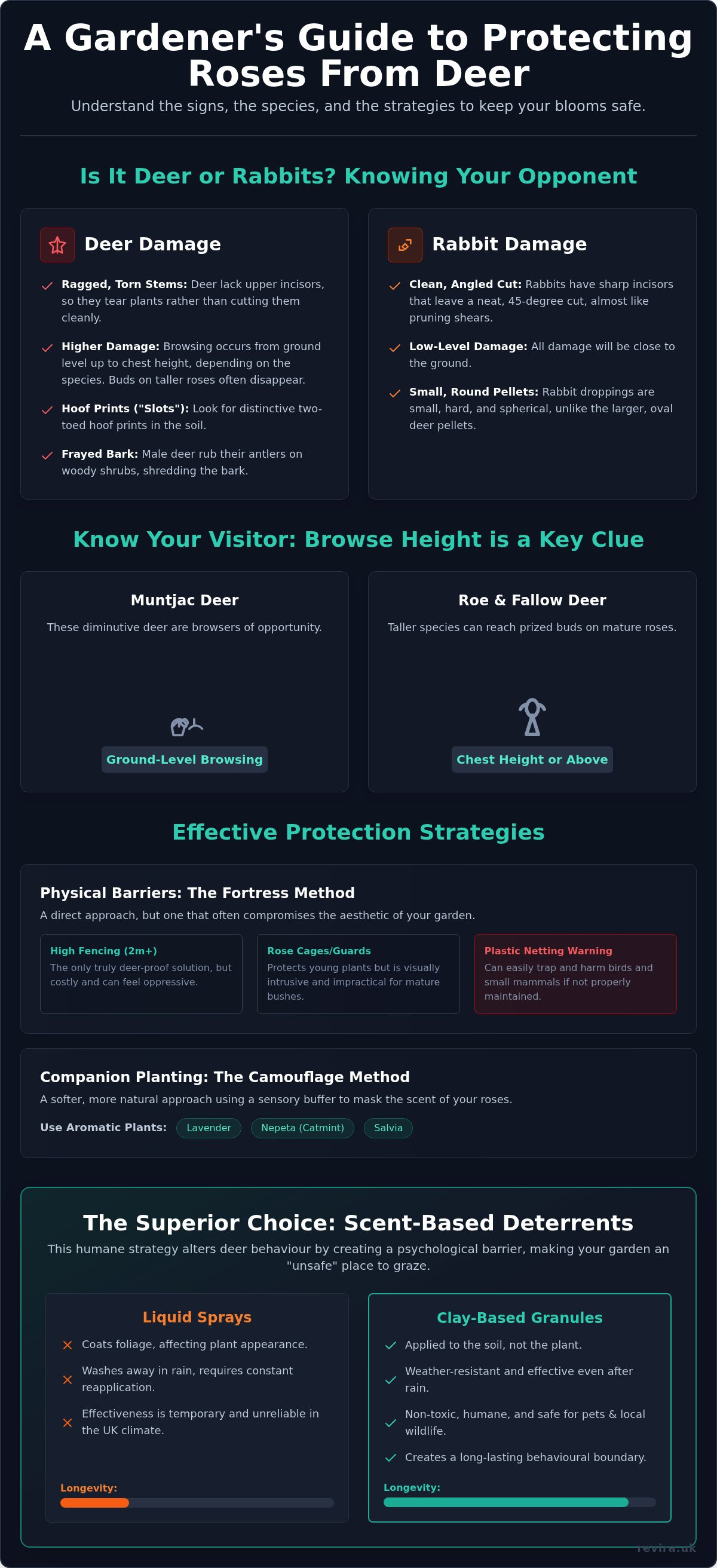
Before you can decide how to protect roses from deer uk, you must be certain they're the culprits. Unlike the clean snip of a pair of secateurs, deer leave a distinctively messy "ragged edge" on stems. This happens because deer lack upper incisors; they're forced to grip the plant against their lower teeth and a hard pad in the roof of their mouth, tearing the tissue rather than cutting it. For many rose growers, the first sign of a visit is the sudden, overnight disappearance of flower buds just as they're about to bloom.
Browse height offers a vital clue to the species visiting your borders. Muntjac are diminutive and browse at ground level, whilst Roe and Fallow deer reach much higher, frequently grazing at chest height or above. If your tallest rose buds have vanished while lower foliage remains, you're likely dealing with larger species. Historically, sunken fence designs were used to manage these boundaries invisibly, but identifying their specific reach is the first step for the modern gardener.
Check nearby woody shrubs for "fraying" where male deer may have rubbed their antlers. This shredded bark and broken twigging indicates they've marked your garden as their territory. This behaviour, combined with the presence of "slots" (two-toed hoof prints), confirms a deer problem.
Deer vs Rabbit Damage: Knowing Your Opponent
It's easy to confuse deer with rabbits, but their feeding methods differ. A rabbit leaves a sharp, clean 45-degree angle cut on a stem, looking almost like a deliberate prune. If the damage is low but the cut is smooth, it's a rabbit. Deer droppings are also larger and more oval than the small, round pellets left by rabbits, helping you identify exactly which guest is dining in your garden.
Physical Barriers and Deer-Resistant Planting
Many gardeners reach for wire mesh when they first notice damage. Unless that mesh stands significantly taller than the average person, a determined Roe or Fallow deer will simply leap over it. For young, vulnerable plants, individual rose cages or tree guards offer a more targeted solution. These provide a physical shield during the critical early stages of growth, though they do little for the plant's aesthetic appeal as it matures. Learning how to protect roses from deer uk often starts with these physical barriers, even if they are only temporary.
Integrating deer-resistant companion plants is a softer approach. Aromatic species like Lavender, Nepeta (Catmint), and Salvia can help mask the tempting scent of rose buds. Whilst not a foolproof barrier, these plants create a sensory buffer zone that makes your roses less obvious to a passing browser. Be cautious with plastic netting; it's often more of a hazard than a help. It can easily trap birds or small mammals if it isn't perfectly tensioned and monitored daily.
Why High Fencing Is Not Always the Answer
Erecting a two-metre perimeter fence is the only way to deer-proof a site completely, but it rarely suits the character of a British cottage garden. Beyond the high installation costs and ongoing maintenance, such structures can feel oppressive. It is often more practical to look at how to protect your garden naturally rather than building a fortress. If you want to maintain your garden's open feel whilst ensuring your blooms remain intact, a humane deer deterrent offers a far more discreet alternative to heavy-duty mesh.
Effective and Humane Deer Deterrents
Understanding how to protect roses from deer uk involves more than just blocking access; it's about altering the animal's perception of your garden. Scent-based discouragement targets a deer's primary survival instinct. By making a rose bed smell "unsafe" or unfamiliar, you create a psychological barrier that is often more effective than a low fence. Deer are cautious creatures; if they sense a potential risk, they'll move on to easier grazing grounds.
Clay-based granules are a superior choice for the conscientious gardener. Unlike chemical sprays that coat the foliage and often wash away during a typical British drizzle, these granules sit on the soil. They provide a steady, long-lasting signal that discourages entry without affecting the plant's health or appearance. Apply these deterrents around the perimeter of your rose garden to create a clear behavioural boundary. Breaking a deer's habitual feeding pattern is essential. Once they identify your prize blooms as a reliable food source, they'll return nightly. Consistent application ensures they seek forage elsewhere.
Choosing a Long-Lasting Deer Repellent
Revira's non-toxic approach is safer for your pets and the local ecosystem. It doesn't rely on poisons, making it a responsible choice for protecting ornamental plants. These granules are specifically formulated to endure the damp UK climate, staying effective when liquid alternatives fail. For detailed guidance on application schedules during the peak growing season, visit our frequently asked questions. This ensures your roses remain a no-go zone for local deer throughout the summer months.
Safeguarding Your Blooms for the Season Ahead
Protecting your garden doesn't require turning it into a fortress. Recognising the ragged stems left by deer and understanding the browse height of the species visiting your borders are the first steps toward a solution. Whilst high fencing is often impractical, combining strategic planting with sensory deterrents offers a balanced way to maintain your garden's character. Learning how to protect roses from deer uk is essentially about working with nature rather than against it.
Our clay-based granules are non-toxic and safe for garden wildlife, providing the long-lasting protection professional gardeners trust. They discourage grazing without compromising the beauty of your roses. Protect your roses today with Revira Deer Deterrent and enjoy the peace of mind that comes with a healthy, intact garden. Your summer display is well worth the effort.
Frequently Asked Questions
How high can a deer jump to reach my roses?
Fallow and Roe deer can jump up to 2 metres if they are sufficiently motivated. They rarely leap into a space where they can't see a clear landing, which is why a 1.8-metre fence is the standard for exclusion. If your roses are tucked into a small, enclosed border, a lower barrier might suffice as deer dislike feeling trapped.
Do coffee grounds or human hair actually stop deer?
Home remedies like coffee grounds or human hair offer very limited protection and often fail once the deer becomes accustomed to the scent. These methods lack the concentrated profiles needed to trigger a genuine flight response. When considering how to protect roses from deer uk effectively, professional-grade deterrents provide a much more reliable and long-lasting behavioural barrier that doesn't wash away instantly.
Which rose varieties are least likely to be eaten by deer?
No rose is truly "deer-proof," but varieties with high thorn density, such as Rosa rugosa, are often less appealing than smoother varieties. Deer prefer the tender, succulent growth found on hybrid teas and floribundas. Choosing "thorny" species can act as a natural deterrent, though they won't stop a hungry deer from nibbling the soft flower buds if other food is scarce.
How often should I apply a deer deterrent in the UK climate?
Application frequency depends on the product, but clay-based granules generally last much longer than sprays in our damp climate. Whilst liquid repellents may need reapplication after heavy rain, granules remain effective for several weeks. It's best to refresh the perimeter every four to six weeks during the peak growing season to ensure the scent boundary remains strong enough to break habitual feeding patterns.