

With the UK's wild deer population now reaching an estimated 2 million, its highest level in over a millennium, finding a reliable deer repellent has become a priority for many homeowners. It's truly disheartening to find your favourite hostas or expensive tulips reduced to stalks after a single night of grazing.
We believe that protecting your property shouldn't mean declaring war on nature. This guide shows you how to safeguard your favourite plants and trees using ethical, scent-based deterrents that respect the local ecosystem and blend seamlessly into your garden's natural beauty. We will explore how to create a discreet, effective boundary that ensures your greenery remains un-nibbled.
Key Takeaways
- Learn to identify the specific "ragged cut" signs of deer browsing to confirm when your garden needs active protection.
- Understand how a scent-based deer repellent utilises a deer's sensitive olfactory system to create a psychological boundary without the need for physical barriers.
- Compare the benefits of granules, sprays, and fencing to find a solution that remains invisible amongst your mulch and preserves your garden's aesthetic.
- Master the seasonal timing of garden defence, focusing on the critical "Spring Surge" when tender new growth is most vulnerable.
- Discover the advantages of non-toxic, clay-based granules that offer a safe and ethical way to protect your plants whilst respecting local biodiversity.
Identifying Deer Damage and Behaviour in British Gardens
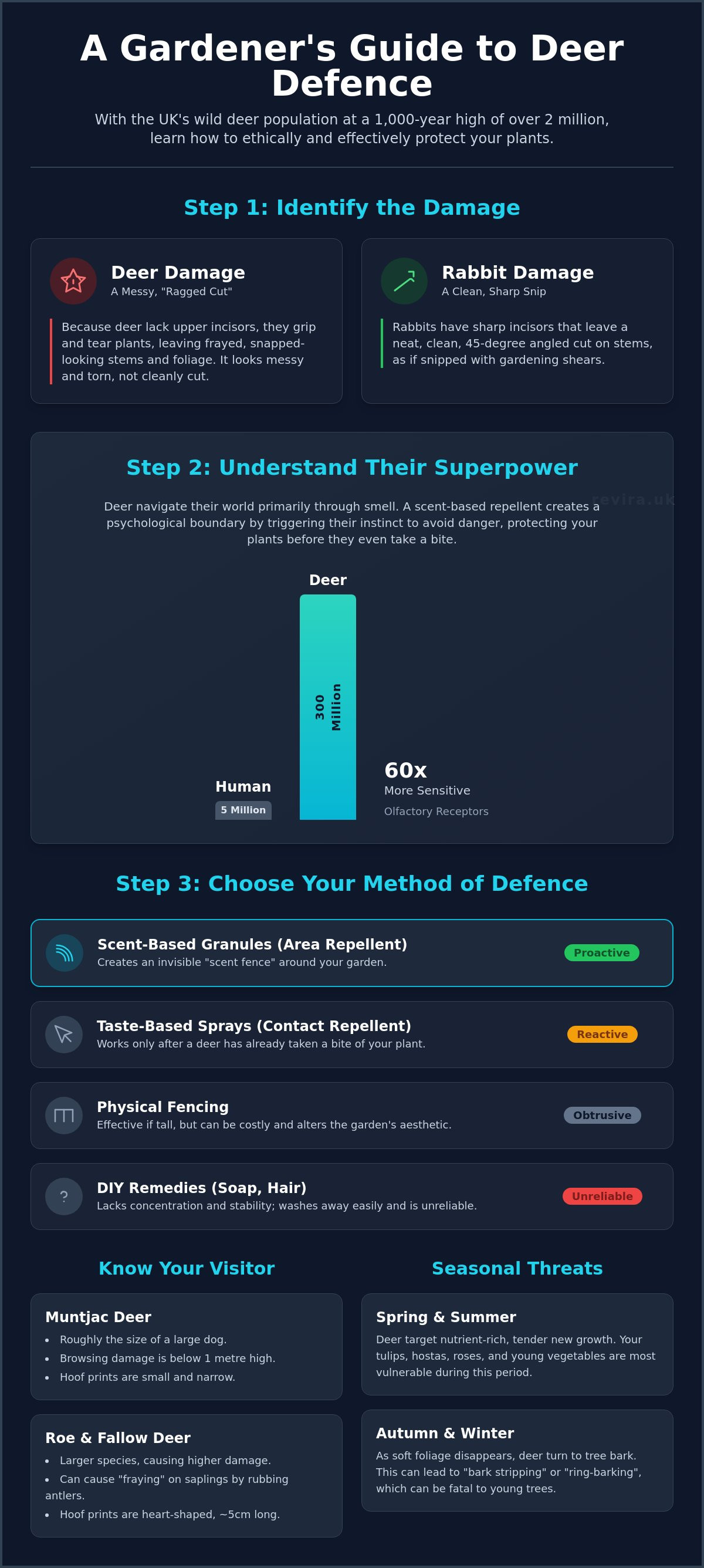
Confirming the presence of deer in your garden is the first step toward effective protection. Unlike the clean, 45-degree snip left by a rabbit's sharp teeth, deer damage is distinguished by a messy, "ragged cut" on stems and foliage. This occurs because deer lack upper incisors. They must grip the plant material and pull it against a hard pad in their upper jaw, leaving behind torn and frayed edges. If you notice your prize roses or hostas look as though they've been roughly snapped rather than neatly pruned, you're likely dealing with deer browsing.
Domestic gardens act as nutrient-rich oases, particularly during the colder months when natural woodland forage becomes scarce. Whilst deer are naturally shy, the high caloric value of "deer-candy" like tulips, geraniums, and young fruit trees often outweighs their fear of human proximity. You may never actually see the culprit, as deer are primarily crepuscular or nocturnal. They prefer to feed during the quiet hours of dawn, dusk, or deep night when they feel most secure. Establishing a deer repellent boundary early in the season is vital, as it signals to these visitors that your garden is no longer a viable food source before they form a regular habit.
Understanding the specific mechanics of how these animals interact with your space is essential for choosing the right Animal repellent strategy. By identifying the height and type of damage, you can determine which species is visiting and how to best discourage them.
Muntjac vs Roe Deer: Who is Visiting Your Garden?
The species of deer determines the height of the damage you'll find. The small, secretive Muntjac is roughly the size of a large dog and typically browses on foliage up to 1 metre from the ground. If you find damage higher up, or see "fraying" where bark is rubbed away on saplings, you're likely hosting larger Roe or Fallow deer. To confirm, check your garden borders for "slots" (hoof prints). Muntjac prints are small and narrow, whilst Roe deer leave a heart-shaped print roughly 5cm long.
The Impact of "Bark Stripping" and "Ring-Barking"
As autumn transitions into winter, deer behaviour shifts from eating soft leaves to targeting the bark of trees and shrubs. This can lead to "ring-barking," where the animal strips the bark around the entire circumference of a trunk. This is often a terminal threat to young saplings because it severs the tree's ability to transport nutrients. It's also important to distinguish feeding from "fraying." Fraying occurs when bucks rub their antlers against young trees to remove velvet or mark territory, which can be just as destructive as browsing. Using a deer repellent that creates a scent-based barrier can help discourage this behaviour by making the area feel less secure for the animal.
The Mechanics of Scent-Based Deer Repellents
To understand why a deer repellent works, one must first understand the biology of the animal it's designed to influence. Deer are highly evolved prey animals. Their survival depends on a sense of smell that is significantly more sensitive than our own. Whilst humans have roughly 5 million olfactory receptors, a deer possesses nearly 300 million. They don't just "smell" their environment; they navigate it through a complex map of chemical signals that warn them of predators, competition, and danger.
Most deterrents on the market fall into two distinct categories: contact repellents and area repellents. Contact products rely on taste, often using bittering agents or sheep fat. The fundamental flaw here is that the deer must actually take a bite of your favourite plants to learn they are unpalatable. In contrast, area repellents use scent to create a psychological barrier. These natural granules act as a "scent fence," emitting a signal that triggers a deer's primal instinct to avoid an area before they ever reach your flowerbeds. If you're looking for a dependable deer deterrent that respects these natural instincts, scent-based granules offer a professional-grade solution.
Traditional home remedies, such as hanging bars of soap or bundles of human hair, are often recommended in gardening circles. However, these methods lack the concentration and stability required for long-term protection. Clay-based granules provide a far more reliable platform. They hold a consistent scent profile that doesn't dissipate after a few days, offering a grounded and practical alternative to DIY experiments.
Why Scent is More Effective Than Taste
Scent-based deterrence is a matter of prevention rather than reaction. By using a deer repellent that appeals to their sense of smell, you prevent the very first bite from occurring. Certain natural scents produce a "flight or fight" trigger in wild cervids, making them feel uneasy about entering a specific space. When a deer encounters this persistent scent boundary, it eventually chooses to alter its foraging route entirely. This creates a lasting change in behaviour, as the animal learns to associate your garden boundary with a sense of potential risk.
The Role of Weather and Rain Resistance
The unpredictable British weather is the primary enemy of most liquid deterrents. A heavy rainstorm can quickly wash away sprays, leaving your plants vulnerable just when the ground is soft and deer are most active. Porous clay granules address this challenge by "locking in" the scent within their structure. They release the deterrent slowly over several months, regardless of the rainfall. For maximum efficacy, we recommend refreshing the boundary twice a year, typically in early spring and late autumn, to ensure the scent signal remains clear and authoritative throughout the changing seasons.
Comparing Deer Deterrents: Granules, Sprays, and Fencing
Selecting the right deer repellent strategy is a balance between efficacy, cost, and the aesthetic you wish to maintain. In the UK, gardeners typically choose between three main methods: physical barriers, liquid sprays, and scent-based granules. Whilst each has its place, the visual impact on your landscape varies significantly. Traditional fencing creates a hard border that is impossible to ignore. Liquid sprays, though effective, often leave a visible white or oily residue on ornamental foliage that can detract from the beauty of your flowerbeds. Granules offer a more discreet alternative. Once applied, they settle amongst the mulch or soil, remaining virtually invisible whilst providing a persistent scent-based boundary.
The "barrier effect" is a critical concept in deer management. It is a common misconception that a standard garden fence will keep deer out; a 1.2-metre picket fence is merely a minor hurdle for a Roe or Fallow deer. They are gifted jumpers that can easily clear low obstacles if they see a food source on the other side. A scent-based deer repellent works differently by creating a psychological wall. Instead of a physical hurdle to jump over, the animal encounters a zone that signals "danger" to its olfactory system. This often proves more effective than a low fence, as the deer chooses to avoid the area entirely rather than testing the boundary. For large perimeters, granules are particularly cost-effective, allowing you to protect your garden's edge without the high expense or labour of professional fence installation.
The Limitations of Physical Fencing
To be truly deer-proof, a fence must be at least 1.8 metres (6 feet) high. For many residential gardens, this height requires planning permission and can leave the space feeling "walled-in" or clinical. There is also a genuine risk of trapping. Deer may find a gap or leap in during a moment of high motivation, only to become panicked when they cannot find their way back out. This can lead to significant damage to both the fence and your plants as the animal struggles to escape. A scent-based boundary avoids this risk, allowing the animal to move freely in the wider environment whilst simply choosing to stay away from your protected greenery.
Liquid Sprays vs Granular Application
The practicalities of application often dictate which method a gardener sticks with long-term. Liquid sprays usually require mixing in a knapsack sprayer, a process that can be messy and time-consuming. There's also the scent profile to consider; many liquid products have a pungent initial odour that is unpleasant for humans. Granules are far simpler to manage. They can be hand-broadcast directly from the container, making them ideal for "spot-protection" around specific favourite shrubs or along a woodland border. They provide a subtle, earthy scent that is unnoticed by people but remains a clear and authoritative signal to any visiting deer.
A Seasonal Guide to Protecting Trees, Shrubs, and Flowers
Effective deer management requires a proactive, year-round approach that adapts to the changing needs of local wildlife. Deer are creatures of habit. They return to the same feeding grounds repeatedly. Breaking this cycle requires a consistent scent signal that remains authoritative regardless of the month. By understanding the seasonal motivations of deer, you can apply your deer repellent more strategically to protect your most vulnerable plants.
The "Spring Surge" is perhaps the most critical period. As the ground warms, deer target emerging bulbs and the tender new growth on hedges. This soft greenery is highly nutritious and difficult for a hungry deer to resist. During the "Summer Maintenance" phase, the goal is to ensure the deterrent boundary remains strong whilst your garden is in peak growth. Whilst food is more abundant in the wild during summer, your ornamental borders remain a tempting dessert. As we move into the "Autumn Protection" stage, the threat shifts. Bucks become more active and begin fraying saplings to mark territory. Finally, the "Winter Shield" approach focuses on preventing bark stripping. When the ground is frozen and forage is scarce, deer will turn to the bark of established shrubs and trees to survive.
Protecting Vulnerable Saplings and Fruit Trees
Young trees are particularly susceptible to terminal damage from ring-barking. To protect them, follow this methodical three-step process:
- Step 1: Identify the "drip line" of the tree. This is the area on the ground directly beneath the outermost circumference of the branches where deer are most likely to stand whilst browsing.
- Step 2: Apply a concentrated ring of granules around the base of the trunk. This creates an immediate "no-go" zone that discourages the animal from approaching the bark.
- Step 3: Monitor for signs of fraying. If you notice buck activity nearby, widen the boundary to create a larger psychological buffer around the sapling.
Safeguarding Ornamental Borders and Rose Gardens
In ornamental gardens, the focus should be on the perimeter rather than individual plants. By creating a continuous scent barrier along the primary entry points, such as gaps in hedges or woodland edges, you can protect the entire border. This is far more efficient than treating every rose bush or hosta. For raised beds and dense ground-cover, granules are ideal because they can be scattered amongst the foliage without leaving a visible residue. This ensures your garden remains beautiful and un-nibbled throughout the year. To secure your garden for the upcoming season, you can order your deer deterrent granules here and establish a lasting boundary.
Revira’s Ethical Approach to Deer Management
Revira’s philosophy is built on the foundation of non-toxic, non-lethal wildlife management. We understand that your garden is a labour of love, and seeing it damaged by browsing is painful. However, we believe that effective protection shouldn't require aggressive chemicals or lethal measures. Our deer repellent granules offer a calm, solution-oriented approach that prioritises the safety of your family, your pets, and the wider garden biodiversity. Because the solution is based on natural clay, there's no risk of harmful runoff or toxic accumulation in your borders. You can enjoy a flourishing outdoor space with the quiet confidence that your methods are as ethical as they are effective.
The simplicity of the granular format is a key part of our commitment to practical reassurance. There's no need for protective clothing, heavy mixing equipment, or complex dilution ratios. You won't find any sticky chemical residue on your favourite flowers or ornamental shrubs. Instead, you get a clean, functional solution that works with the natural world rather than against it. This grounded approach ensures that your garden remains a safe haven for children and domestic animals whilst providing a clear, scent-based boundary that deer instinctively respect.
Why Non-Toxic Deterrents are Better for Your Garden
Avoiding harsh chemical pesticides is essential for anyone who values a healthy soil microbiome. Many traditional deterrents rely on substances that can linger in the earth or harm beneficial insects like bees and ladybirds. Revira granules take a different path. They are designed to break down naturally over several months, eventually becoming part of the soil structure itself. This embodies the "Conscientious Guardian" mindset. It allows you to protect your property whilst maintaining a deep sense of care for the environment. By choosing a non-toxic path, you ensure that your garden remains a vibrant, living ecosystem where humans and nature can coexist in a respectful balance.
Long-Lasting Protection Without the Mess
The granular format is specifically designed for the practical needs of the busy UK gardener. It eliminates the mess of mixing sprays and the worry of chemical drift onto your vegetables or patio furniture. The application is as simple as broadcasting the granules by hand or with a basic spreader. Once they are on the ground, they are incredibly discreet. They blend into bark mulch or soil, preserving the aesthetic beauty of your landscape whilst they work. With a single application providing reliable protection for up to 6 months, you can enjoy long-term peace of mind. Protect your garden today with Revira Deer Deterrent and discover a more grounded, responsible way to safeguard your greenery.
Establish a Lasting Boundary for Your Garden
Protecting your outdoor space from browsing damage is a matter of understanding deer behaviour and communicating a clear boundary. By identifying the specific signs of damage early and applying a seasonal strategy, you can keep your favourite plants safe without resorting to harsh chemicals or unsightly fences. A scent-based deer repellent works with the animal's natural instincts, creating a psychological barrier that encourages them to find forage elsewhere. This approach ensures your landscape remains beautiful whilst respecting the local ecosystem.
Revira has been trusted by British gardeners for over 20 years to provide reliable, non-toxic solutions that are safe for pets and children. Our clay-based granules offer long-lasting protection for up to 6 months with a single application, giving you the freedom to enjoy your garden without the constant worry of nibbled stems. You can maintain a flourishing, productive space whilst remaining a conscientious guardian of the natural world.
Browse our range of ethical deer and wildlife deterrents and reclaim the peace of mind you deserve. Your garden is a sanctuary; we're here to help you keep it that way.
Frequently Asked Questions
Do deer repellents actually work in a typical UK garden?
Yes, scent-based deterrents are highly effective when used as part of a consistent management strategy. They create a psychological boundary that wild deer instinctively avoid. Whilst no method is 100% foolproof in extreme famine conditions, quality granules significantly reduce browsing damage in most UK residential settings. It's a reliable way to protect your plants without the need for unsightly physical barriers or complex installations.
How often do I need to reapply deer repellent granules?
You should typically reapply the granules every six months to maintain a clear scent signal. In the UK, the best times for application are early spring to protect emerging growth and late autumn to prevent winter bark stripping. This semi-annual schedule ensures the boundary remains authoritative throughout the most vulnerable seasons. Regular maintenance prevents the scent from fading and keeps the deterrent effective year-round.
Is deer repellent safe to use around dogs and cats?
Yes, Revira's clay-based granules are non-toxic and safe for use in gardens where pets and children play. Because the product relies on natural scent signals rather than harmful chemical pesticides, it doesn't pose a risk to your domestic animals or the wider garden biodiversity. It's a conscientious choice for a family home, providing peace of mind whilst protecting your favourite ornamental plants and trees.
What are the best plants to use alongside a deer deterrent?
Choosing "deer-resistant" plants like lavender, foxgloves, and buddleia provides an extra layer of protection. These species are naturally less palatable due to their strong scents, fuzzy textures, or bitter tastes. Combining these strategic planting choices with a deer repellent boundary creates a robust, multi-layered defence. This makes your garden far less attractive to visiting herds whilst maintaining a beautiful and diverse landscape for you to enjoy.
Can I use deer repellent on my vegetable patch or fruit trees?
You can certainly use granular deterrents around the perimeter of your vegetable patch or the base of fruit trees. Since the granules are applied to the soil rather than the edible parts of the plant, they don't leave a chemical residue on your harvest. This makes them a practical tool for protecting your home-grown produce ethically. It ensures your fruit and vegetables reach maturity without being sampled by local wildlife.
How much deer repellent do I need for a standard garden perimeter?
A 2-litre container of granules is generally sufficient to protect a perimeter of up to 250 square metres. For a standard UK garden, this often covers the primary entry points or the most vulnerable ornamental borders. The application process is a simple matter of hand-broadcasting the product where it is needed most. This allows you to secure a large area quickly and cost-effectively without the need for any specialist equipment.
Will the scent of the repellent be offensive to humans?
No, the scent of granular deterrents is very subtle to the human nose and often described as earthy. Whilst deer have a sense of smell hundreds of times more sensitive than ours, humans will rarely notice the fragrance once the granules have settled into the soil or mulch. It won't interfere with your enjoyment of the garden or your ability to host outdoor gatherings during the summer months.
Can deer become "immune" to the scent of a repellent over time?
Deer don't become immune to the scent, but they are intelligent animals that can become "habituated" if the signal is weak or inconsistent. By using a high-quality deer repellent and maintaining the boundary with regular reapplications, you keep the signal clear and authoritative. This prevents the animals from testing the area and ensures the psychological barrier remains a powerful deterrent that influences their foraging routes long-term.